
There seem to have been a number of cities named "Abila". One of those being Abila of the Decapolis, directly east of the southern tip of the Sea of Galilee. Whilst the Gospels show Yeshua/Jesus actively ministering in the Decapolis region (Mark 7:31; Matthew 4:25; Mark 5:20), there is no specific mention of Him visiting this Abila. In Luke 3:1 we read, "Now in the fifteenth year of the reign of Tiberius Caesar, Pontius Pilate being governor of Judea, Herod being tetrarch of Galilee, his brother Philip tetrarch of Iturea and the region of Trachonitis, and Lysanias tetrarch of Abilene." (Luke 3:1) "The region of Trachonitis" where Philip was tetrarch basically consisted of what is now known as the Golan. His brother, Antipas, was tetrarch of the Galilee & Perea (now southern Jordan). The Decapolis was an autonomous region. The fragmentary inscription on the left above comes from the Abila of the Decapolis. ["Abila" is outlined in yellow]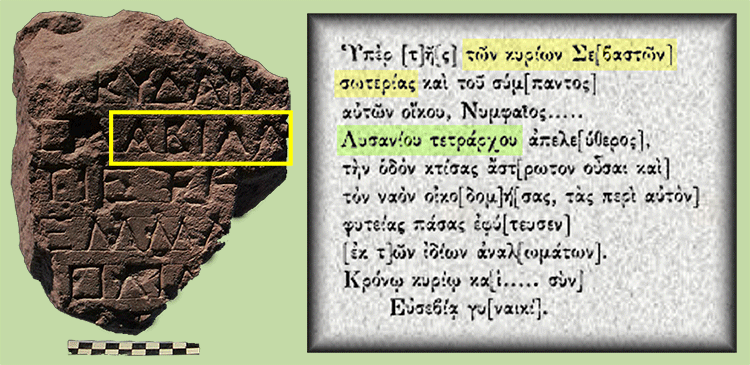
The question that has been discussed by many is, where was the Tetrarchy of Abilene which Luke 3:1 refers to? Because of the dating Luke gives to this it has to be outside of the influence of Herod's sons and separate from the Decapolis. The Abila which best fits this description is situated between Damscus and Baalbeck, specifically 18 miles northwest of Damascus. This suggests that the Tetrarchy of Abilene was in this region, just to the north of Herod the Great's domain.
Equally there are a number of people known as Lysanias. One 60 years too early and others later than Luke's account. This has led some scholars to question Luke's historical accuracy and thus place this Gospel as a much later date. However, there are two inscriptions which refer to tetrarch named Lysanias in the region we are speaking of. The most imprtant one for our purposes was discovered in 1737 by the famous English traveler Dr. Richard Pocock. His description of his discovery is to be found in his work, "A Description of the East - Book 2". It goes like this:
"...there is a ruined church on top of it, the place is called Nebi Abel (Prophet Abel); here, they say, Cain buried Abel, ... I went to see this place from Damascus, and found a most beautiful church uncovered, ... I hoped for some light as to the founder of it, from a Greek inscription which I saw on a stone about four feet wide, and three deep, that was fixed inside the church, but some of it had been broken off; so that the latter part of the lines are lost; ... and afterwards makes mention of Lysanias, tetrarch of Abilene". (outlined in green)
The above part quotation is taken from John Pinkerton's "A General Collection of the best & most interesting Voyages and Travels in all parts of the World" vol.10, London, 1811. The Byzantine church he mentions is now completely destroyed, the inscription lost and I have been unable to discover any picture of the original inscription! However, Pocock did publish the inscription in the "Corpus Inscriptionum gr�corum", Berlin, 1853. The Greek given on the left of the above picture is taken from this, with the reconstructions he offers. This is very helpful as it speaks of "the salvation of the Lords Augusti" (outlined in yellow) ~ it uses the established formula of ??? ?????? ???????? for "Lords Augusti". This means the inscription cannot be earlier than Tiberius as the only time two people bore the title "Augustus" at the same time: Tiberius, son of Augustus, and Livia, wife of Augustus. Livia, however, only took the title "Julia Augusta" after the death of her husband in 14CE. She died in 29CE, thus dating this inscription firmly in the period Luke refers to. Thus, once again, the historical accuracy of the Bible is confirmed.
[Stone fragment from Area A with the name of ABILA visible on its surface. From: users.stlcc.edu/mfuller/abila/AbilaAreaA.html Copyright: Professor Michael J. Fuller, Ph.D, St. Louis Community College. Used here purely for educational/informational, non-profit purposes.]